The study will explore the existing literature within the frameworks of the composition of e-Services, Web Services and the Semantic Web Services. This will be followed by the identification of current drawbacks with regards to e-Services, Web Services and Semantic Web Services compositions (incl. the study of AI-inspired content markup languages and standards/languages, such as OIL, DAML+OIL, UDDI, WSDL, DAML-L, and DAML-S). The above study will then be integrated to propose a proper characterisation and simulations of IeSs as well as the choreography thereof. In the role of the evidence and developmental explanation, this will form the basis for the construction of a framework that will facilitate the choreography of IeSs. As part of pragmatic steps, a specific realistic business scenario, such as e-Mentoring[1], will be used to provide an application of the proposed framework, which will be evaluated in order to assess the efficiency and applicability. The pragmatic steps will consist of the following stages together with the integration of different methods in brackets: (1) the representation of e-Mentoring as components of IeSs (interpretation); (2) modelling e-Mentoring as a choreographed set of IeSs (experiment and interpretation using DAML-S, PDDL, and business-process modelling languages); (3) implementation of IeSs-based e-Mentoring scenario (observation using existing tools e.g. ebXML); and (4) evaluation of the implemented IeSs-based e-Mentoring scenario (observation). The next section concludes this short paper.
[1] e-Mentoring can be explained as a process where a mentee and a mentor communicate via ICT technologies in order to solve certain problems.
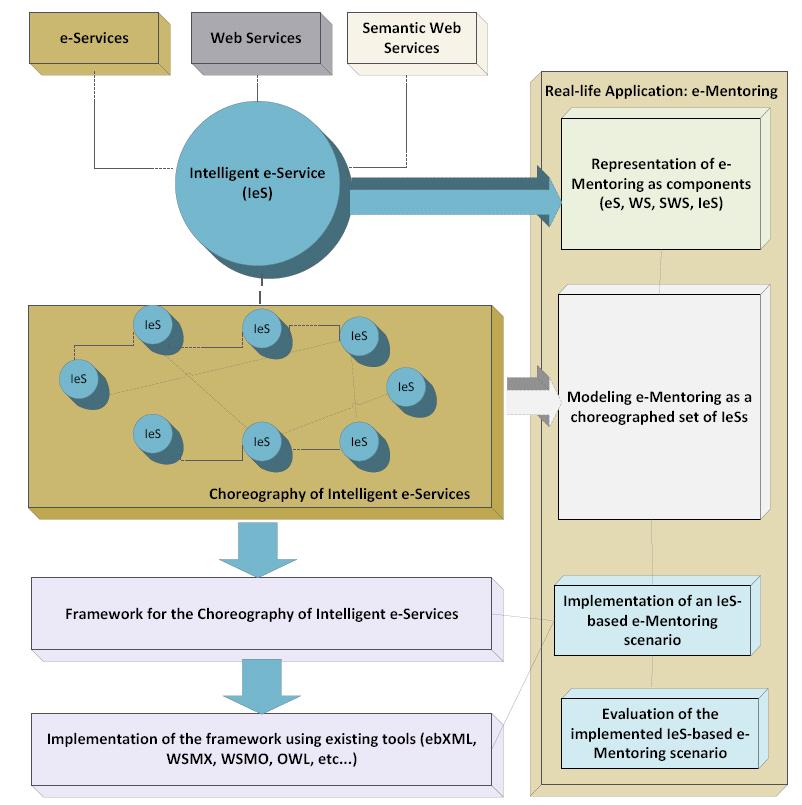
The pragmatic steps will consist of the following stages together with the integration of different methods in brackets.
· The representation of e-Mentoring as components of IeSs (interpretation);
· Modelling e-Mentoring as a choreographed set of IeSs (experiment and interpretation using DAML-S, PDDL, and business-process modelling languages). A detailed analysis of the e-Mentoring ontology domain will be modeled. This includes the definition of the concepts, relations, and instances that are going to be used in representing the e-Mentoring domain.
· Implementation of IeSs-based e-Mentoring scenario (observation using existing tools e.g. ebXML). The Semantic Annotations for WSDL (SAWSDL) will be used to add semantic annotations to WSDL components which will give semantic meaning to the intelligent services; and
· Evaluation of the implemented IeSs-based e-Mentoring scenario (observation). Evaluation will be done as major milestones (i.e. the three main research topics above) are completed.